Equifax National Market Pulse Data Shows U.S. Consumer Debt Accelerating
PR Newswire
ATLANTA, Feb. 24, 2026
While Delinquency Rates Have Begun to Ease, They are Still Elevated Relative to Pre-Pandemic Norms
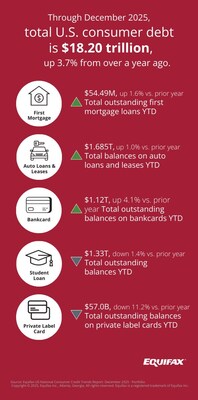
ATLANTA, Feb. 24, 2026 /PRNewswire/ -- Equifax® (NYSE: EFX) has released its Market Pulse Fourth Quarter U.S. Consumer Credit Trends, which includes U.S. national consumer credit data and trends through December 2025 sourced from Equifax proprietary data. According to Equifax, the rate of increase for overall consumer debt accelerated in December 2025 compared to the same month in 2023 and 2024, with total U.S. consumer debt reaching $18.20 trillion by the end of 2025. In addition to consumer debt growth accelerating, a persistent K-shaped divide underscores a widening financial chasm between income brackets.
"Average subprime credit card utilization remained flat at 75.6% from quarter three to quarter four of 2025, despite rising prices, higher interest rates, and increased delinquencies," said Maria Urtubey, Market Pulse Advisor at Equifax. "However, topline improvements can mask financial stress in certain groups. While higher-income consumers continue to benefit from asset inflation and expanded credit availability, many others remain under pressure, and the broader economic picture still shows uneven financial health. This divergence reinforces the K-shaped economic divide observed in prior quarters and underscores the need to evaluate multiple factors when gauging the financial health of American consumers."
In the fourth quarter of 2025, Equifax data shows that delinquency rates across several major lending products have begun to ease from more recent highs, though they remain elevated relative to pre-pandemic norms. As of December 2025, 5.7% of consumers had at least one payment 60+ days past due (DPD)—down from a peak of 6.8% in the third quarter. Despite ongoing economic pressures including inflation, tariffs, and slower job growth, overall consumer financial health has remained relatively consistent.
Looking ahead, seasonal patterns are expected to support near-term credit performance. Delinquencies typically ease as tax refunds arrive and larger refunds could provide additional relief to pay down debt.
Key Insights
- Bankcard Balances Continue to Grow While Private Label Credit Contracts
Total bankcard balances increased to $1.12 trillion, up 4.1% year-over-year, while 60+ day bankcard delinquency declined to 3.03% from 3.16% a year ago. Average bankcard utilization edged down slightly to 21.2%, a decline driven primarily by rising credit limits—which have risen roughly 6.5% year-over-year—rather than being driven by a pullback in card usage. Importantly, utilization levels have remained broadly stable around 21% since August 2023, underscoring a steady consumer reliance on revolving credit.
At the same time, private label card balances fell 11.2% year-over-year and accounts declined 21.4%, reflecting a continued consumer shift toward general-purpose credit products.
- Auto Credit Stays Resilient as Leasing Gains Momentum
Auto loan and lease balances reached $1.685 trillion in December, up just 1% year-over-year, as consumers continue adapting to elevated vehicle prices via longer loan terms and alternative financing structures. Severe auto delinquency (share of balance 60+ DPD increased to 1.61%, up three basis points year-over-year, while auto write-offs decreased to 25.9 basis points. Delinquency trends have remained largely stable since late 2023, including within the subprime segment, where auto loans continue to rank as the top payment priority for borrowers.
Leasing activity accelerated in the fourth quarter, with outstanding lease balances up 7.6% year-over-year to $95.8 billion. This growth reflects affordability-driven consumer behavior as borrowers seek lower monthly payments amid high vehicle prices, even as lease rates remain elevated. Leasing remains concentrated among prime and near-prime consumers, while lower-credit tier borrowers continue to gravitate toward the used vehicle market, where limited off-lease supply has kept prices elevated.
- Student Loan Delinquencies Stabilize as New Risks Emerge
Outstanding student loan balances totaled $1.33 trillion, down 1.4% year-over-year. The severe delinquency rate (calculated as the share of non-deferred balances 90+ DPD or in bankruptcy) measured 16.39%, showing signs of leveling off following earlier repayment disruptions tied to the resumption of payments. Looking ahead, the restart of wage garnishment is expected to influence repayment behavior and could affect how consumers prioritize student loan payments relative to other financial obligations.
"Historically, consumers have prioritized mortgage and auto obligations over other forms of debt," said Urtubey. "However, renewed enforcement on student loans, persistent inflation, and high borrowing costs may begin to reshape payment hierarchies and introduce stress into credit categories that have been relatively insulated in the past."
Month-Over-Month and Year-Over-Year Results
Total Consumer Debt Balances | |||
Month | Total Consumer Debt | MoM Change (%) | YoY Change (%)
|
October 2025 | $18.09 | 0.3 % | 2.9 % |
November 2025 | $18.10 | 0.1 % | 2.9 % |
December 2025 | $18.20 | 0.5 % | 3.7 % |
First Mortgage Balances | |||
Month | First Mortgage Balances | MoM Change (%) | YoY Change (%) |
October 2025 | $12,748 | 0.3 % | 2.9 % |
November 2025 | $12,755 | 0.1 % | 2.9 % |
December 2025 | $12,822 | 0.5 % | 4.3 % |
Home Equity Lines of Credit (HELOC) Balances | |||
Month | HELOC Balances ($B) | MoM Change (%) | YoY Change (%) |
October 2025 | $413.1 | 1.4 % | 12.0 % |
November 2025 | $417.4 | 1.0 % | 12.2 % |
December 2025 | $421.7 | 1.0 % | 12.6 % |
Auto Loan Balances | |||
Month | Auto Loan Balances ($B) | MoM Change (%) | YoY Change (%) |
October 2025 | $1,589 | 0.1 % | 0.8 % |
November 2025 | $1,590 | 0.1 % | 0.8 % |
December 2025 | $1,589 | -0.1 % | 0.6 % |
Bankcard Balances | |||
Month | Bankcard Balances ($B) | MoM Change % | YoY Change (%) |
October 2025 | $1,083.5 | 0.0 % | 3.7 % |
November 2025 | $1,090.5 | 0.6 % | 3.8 % |
December 2025 | $1,123.9 | 3.1 % | 4.1 % |
Student Loans Balances | |||
Month | Student Loan Debt ($B) | MoM Change % | YoY Change (%) |
October 2025 | $1,349 | 0.6 % | -0.2 % |
November 2025 | $1,344 | -0.4 % | -0.3 % |
December 2025 | $1,330 | -0.3 % | -1.4 % |
Equifax has been tracking U.S. National Consumer Credit Trends for more than 20 years. Monthly reports can be found on Equifax.com. These reports track originations, balances and delinquencies on U.S. consumer mortgages, auto loans and leases, student loans, bankcards and private label credit cards, and personal loans. To explore Equifax tools that deliver U.S. National Consumer Credit Trends data and key market metrics click here.
*To view the included graphic, click here.
ABOUT EQUIFAX INC.
At Equifax (NYSE: EFX), we believe knowledge drives progress. As a global data, analytics, and technology company, we play an essential role in the global economy by helping financial institutions, companies, employers, and government agencies make critical decisions with greater confidence. Our unique blend of differentiated data, analytics, and cloud technology drives insights to power decisions to move people forward. Headquartered in Atlanta and supported by nearly 15,000 employees worldwide, Equifax operates or has investments in 24 countries in North America, Central and South America, Europe, and the Asia Pacific region. For more information, visit Equifax.com.
FOR MORE INFORMATION:
Tiffany Smith for Equifax
mediainquiries@equifax.com

 View original content to download multimedia:https://www.prnewswire.com/news-releases/equifax-national-market-pulse-data-shows-us-consumer-debt-accelerating-302696067.html
SOURCE Equifax Inc.
